Sustainability at GitLab

GitLab's sustainability strategy is driven by our commitment to delivering results for our customers while creating value for all of our stakeholders. As our company has grown, so has our commitment to integrating sustainability throughout the business.

Our FY26 Sustainability Update details our key sustainability focus areas, including our policies, actions, governance mechanisms, and performance metrics.
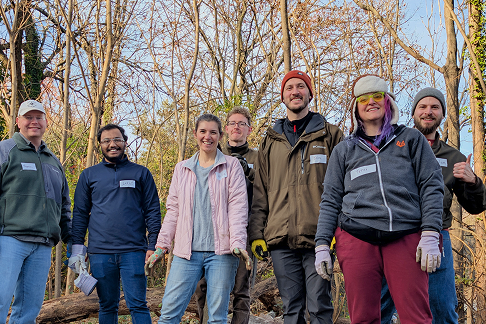
A group of GitLab team members volunteering together outdoors on a sunny day.

From our CEO

GitLab is uniquely positioned at the center of how teams and AI agents build and ship secure software faster, and that position comes with responsibility. As sustainability expectations continue to rise, we're committed to being a long-term partner our customers can trust. Our Sustainability Program helps them move forward on their commitments while delivering meaningful impact for the planet and communities around the world.

Bill Staples
Chief Executive Officer, GitLab

Sustainability Oversight

Our Sustainability Team creates and maintains GitLab's sustainability strategy and programs by driving and integrating responsible business practices and environmental, social, and governance regulatory compliance.

  • Board: The Nominating and Corporate Governance Committee oversees company programs relating to corporate responsibility and sustainability.

  • Senior Director of Sustainability: Leads the sustainability function, reporting to the Chief Legal Officer (CLO) and Head of Corporate Affairs weekly and GitLab's senior executives as needed.

  • Sustainability Advisory Committee: A cross-functional group that provides feedback on sustainability objectives, communicates sustainability information across the business, and supports regulatory and voluntary sustainability reporting.

FY26 awards and recognition

  • Built In 2026 Best Remote Place to Work

  • Disability:IN 2024 Best Places to Work for Disability Inclusion

  • Fortune 2025 Best Workplace in the Bay Area

  • Fortune 2025 Best Workplaces in Technology

  • Great Place to Work certified Apr 2025-Apr 2026

  • Institutional Shareholder Services Prime status

  • MSCI AA ESG Rating, as of Q1 FY27

  • US News Best Information Technology Companies to Work For 2025-2026

  • US News Best Companies to Work For Overall 2025-2026

  • US News Best Companies to Work For West 2025-2026

Our sustainability pillars & FY26 highlights

Trust and Transparency

We consider trust and transparency to be fundamental to serving our customers and the broader community — strengthening collaboration, deepening relationships, mitigating risks for our stakeholders, and creating efficiencies that benefit everyone we serve. We seek to build and maintain trust through our approach to strong governance, product responsibility, security, and ethics.

Key topics:

  • Information security and data privacy
  • Responsible product development
  • Business ethics

FY26 Highlights

  • Responsible AI: GitLab is among the first SaaS companies and the first DevSecOps platform to achieve ISO 42001, which is designed to help organizations develop, provide, or use AI systems responsibly.

  • Trust Center: Added GitLab's ISO 42001 certification to the Trust Center and by the end of FY26, our customers had utilized the center through over 24,000 document interactions, including over 2,000 downloads and views of our System and Organization Controls (SOC) 2 report.

  • Secure by design: As a voluntary signatory to the CISA Secure by Design pledge, publicly reported on progress toward the pledge goals, including a rollout of multi-factor authentication, reduction of default passwords, publication of resources including secure coding guidelines that contain descriptions and guidance on addressing security vulnerabilities commonly identified in the GitLab codebase, development of an incident response guide, and use of our Open Source Security at GitLab repository.

  • AI transparency: Continued to expand our AI Transparency Center to provide customers with information on our approach to responsible AI development and deployment.

  • Product security: Advanced product security as a trust enabler and competitive differentiator, led by our Product Security guiding principles. This included operationalizing our Product Security Risk Register as a single system of record, improving consistency and accountability in risk-informed product decisions.

Planet

GitLab recognizes the responsibility to take meaningful action to reduce our greenhouse gas (GHG) emissions and help protect our planet, not only to benefit the environment, but to also create long-term value for our stakeholders. We work to reduce our environmental impact and provide clear, accurate data that helps customers meet their own climate commitments.

Key topics:

  • Climate action

FY26 Highlights

  • Green DevOps: In response to growing customer requests, launched a Green DevOps Working Group to embed sustainability throughout the software development lifecycle. This includes a focus on five key areas: cloud sustainability, CI/CD pipeline sustainability, sustainable AI, community engagement and innovation, and reporting and analytics. In FY27, published Pipeline Sustainability, offering customers practical guidance on measuring and reducing the carbon emissions from their CI/CD pipelines. Also added sustainability criteria to our Model Vendor Selection Guidelines, signaling an expectation for vendors to adopt sustainable practice and be transparent about the energy consumption and carbon emissions of their AI models.

  • Energy certificates: Purchased and retired carbon removal credits to cover 21,086 tonnes of CO₂e of GitLab's emissions.

  • Supplier engagement: Continued pursuit of our aspirational science-aligned supplier engagement target to reduce our Scope 3 emissions: 70% of our suppliers (by emissions) will have science-aligned climate targets by FY29. Strengthened supplier expectations by expanding the Environmental Sustainability section of our Partner Code of Ethics, requesting suppliers to measure their GHG emissions annually, disclose results to GitLab if not publicly available, establish a science-aligned reduction target, and report progress toward that target as requested.

  • Employee engagement and learning: Launched our first Earth Month campaign in partnership with Mammoth Climate, an employee engagement platform, to expand climate literacy across our workforce, empower team members to take climate action at work and at home, and raise awareness of GitLab's sustainability programs.

People and Communities

We strive to foster a culture of excellence that empowers team members and the broader GitLab community to bring their full selves to their work, contribute their unique skills, and create meaningful impact for our customers.

Key topics:

  • Talent and engagement
  • Diversity, inclusion, and belonging
  • Social impact

FY26 Highlights

  • A strong culture: When surveyed, 92% of team members say GitLab is a great place to work and 96% of team members said that when you join GitLab you are made to feel welcome.

  • Customer collaboration and innovation: Our GitLab Co-Create Program allowed customers to work directly with our product and engineering teams to develop new features and enhance existing ones. 23 enterprise organizations collectively contributed 534 merge requests across GitLab's open source ecosystem.

  • Support for community organizations: As part of our GiveLab 30 Days of Impact campaign, we brought together 448 participating team members who volunteered more than 625 hours to support 48 nonprofit organizations across 11 different countries.

  • GitLab Foundation: Donated 163,555 shares of GitLab's Class A common stock, totaling over $7 million, to support the GitLab Foundation's pursuit of a world in which one million more people can afford a better life.

Additional Resources

Resource

Download our FY26 Environmental Sustainability Summary

Start building faster today

See what your team can do with the intelligent orchestration platform for DevSecOps.