Published on: June 10, 2026
5 min read
GitLab Flex: Commit once, reshape your seats and AI spend
In the agentic era you can't predict seats, AI usage, or which capabilities you'll need next. GitLab Flex is one commitment that adjusts as your needs change.


The agentic era made your needs harder to predict, and the way you buy software hasn't caught up. Six months out, you don't know how many seats you'll need, how much AI your teams will consume, or which new capabilities you'll want to turn on. Yet the contract you sign today fixes all three up front and won't budge until renewal. GitLab Flex was built to solve this predicament. It's one annual commitment you can reshape month to month across seats, AI usage, and new capabilities, without re-procurement.
Fixed contracts, moving needs
The shift to agentic software engineering introduced uncertainty on three fronts at once:
- How many seats. The agentic era is changing who builds. Some companies are adding people who never worked in GitLab before so they can build directly on the platform, and want to grow seats. Others are reshaping their org structure and contractor mix around agents, which can push seat needs up or down. Your seat count six months out moves in both directions, and an annual contract locks you in with a single guess.
- How much AI usage. Agent usage grows on its own curve of use cases, enablement, and technology advancements.
- Which capabilities. New agentic infrastructure capabilities ship constantly. You can't know at signing which ones you'll want to adopt mid-year.
A traditional contract asks you to lock all three in advance and live with the guess until renewal. Guess high and you overpay for idle seats and capacity you never use. Guess low and adopting anything new means re-opening procurement cycles that stall the team right when it has momentum. Either way, the contract is fixed while your needs keep moving.
Annual budgets adapted monthly
GitLab Flex is one annual dollar commitment against a published rate card. From that single commitment you draw down platform seats, GitLab Credits, and eligible usage-based capabilities — across GitLab.com multi-tenant SaaS, Self-Managed (including air-gapped), and GitLab Dedicated single-tenant SaaS. The point is that the commitment flexes on exactly the three things you can't predict.
Adjust seats without waiting for renewal. When a team wraps a project and rolls off, you don't keep paying for idle seats until the contract comes up again. You can reallocate next month's reservations toward another team's seats, or toward AI usage inside the existing agreement.
Scale AI usage with predictable economics. Consumption draws from your annual commitment at the published rate. Usage above the full commitment bills on-demand at $1 per credit, so a busy month doesn't turn into a surprise. Larger commitments unlock better unit pricing, and reserved capacity costs less than unplanned usage.
Add new capabilities without new procurement. Eligible capabilities released after you sign land on the same rate card. When you want to turn one on, you draw it from the commitment you already have without the added steps of re-procurement.
If you've used consumption pricing elsewhere — cloud credits, observability credits — the drawdown will feel familiar. Here's what's different: With Flex, your seats and your usage live under the same commitment, so you can move budget between them. Most models keep seat licenses and usage credits in separate buckets you can't rebalance without going back to the table.
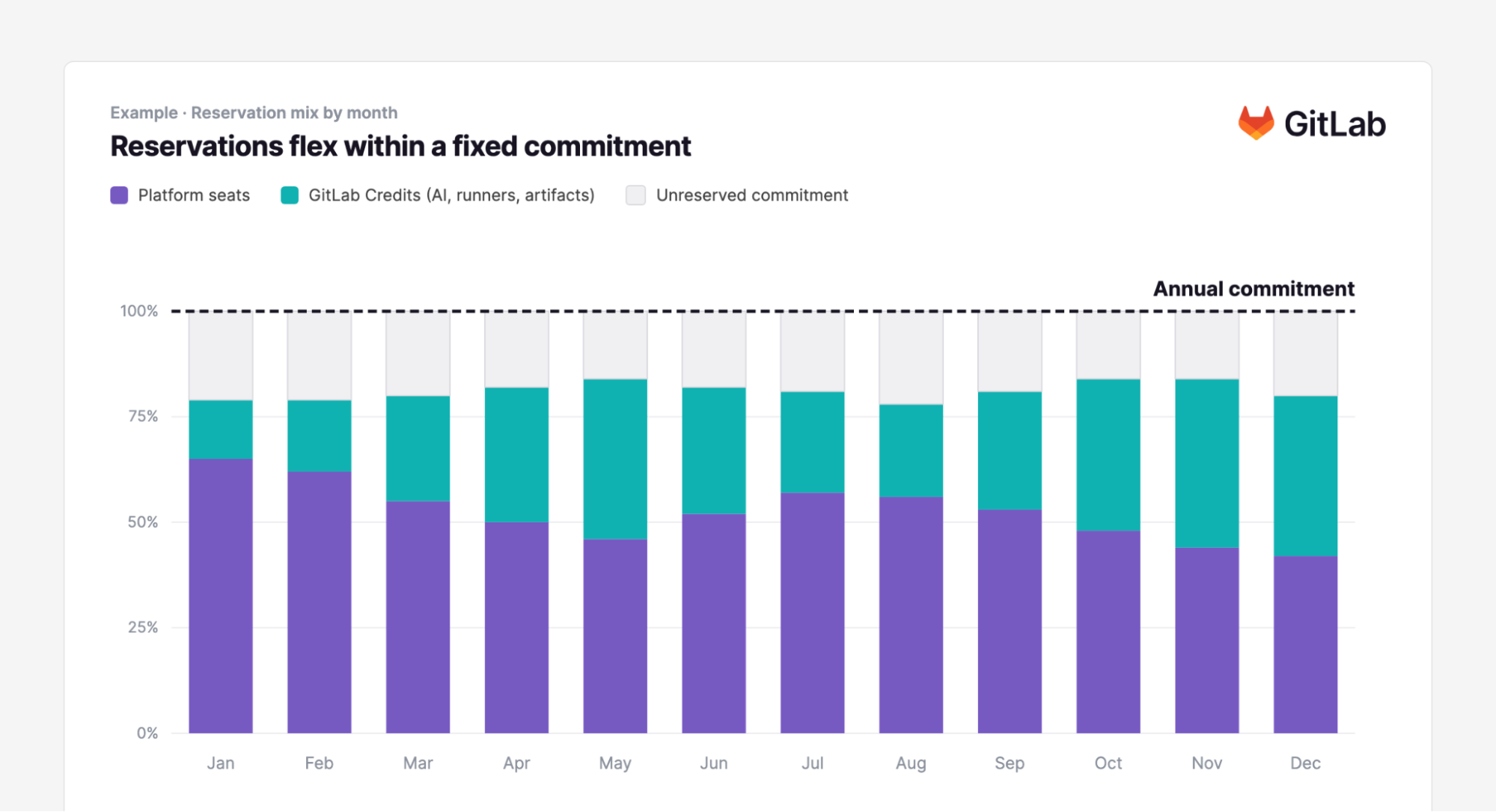 One annual commitment. Monthly reservations across seats and usage-based GitLab Credits. Reshape spend as needs shift. No amendment required.
One agreement, any mix
A single Flex agreement can combine any of the following, all drawing from the same annual commitment:
- Platform seats. GitLab Premium and Ultimate at published rates, with volume discounts tied to your commitment level. (The Flex volume discount is the starting point for seat discounts, automatically applied based on total commitment size. Seat discounting can go above the Flex discount level with additional approvals.)
- GitLab Credits. Credit-metered capabilities like GitLab Duo Agent Platform, hosted runners, and artifact management, each at a published credit rate.
- Every deployment type. GitLab.com, Self-Managed, Dedicated, and air-gapped, all under one agreement — so your mix can shift over the term without restructuring.
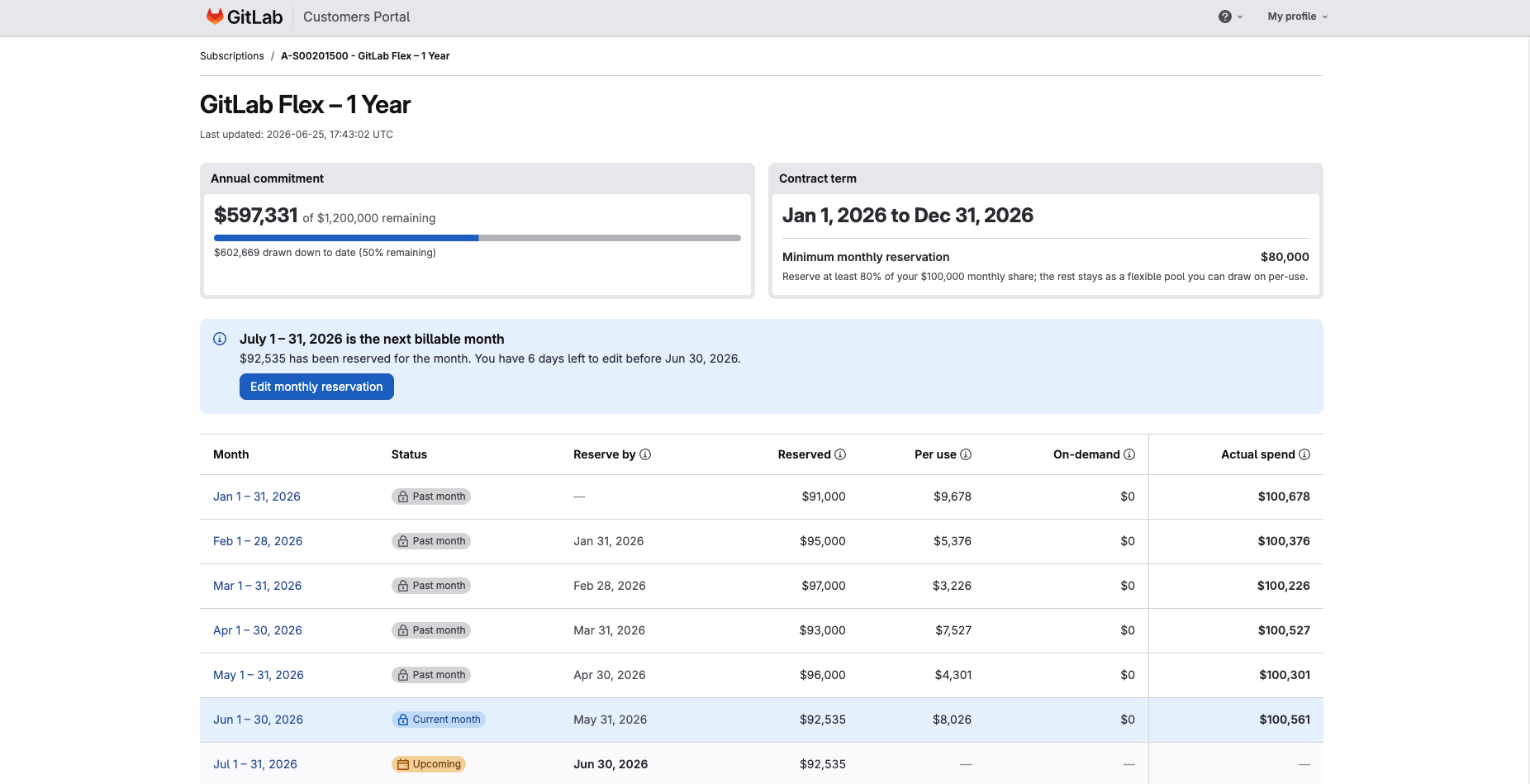 Adjust monthly reservations across seats and usage-based GitLab Credits. Reshape spend as needs shift. No amendment required. (The image above is illustrative of the product in a customer portal, actual layout and experience subject to change.)
Volume economics with spend controls
- Larger annual commitments unlock better unit pricing across the rate card, and reserved capacity costs less than unplanned usage.
- Subscription-level and per-user caps help your team stick to budgets along with admin controls at the project-group level.
- Unreserved seats draw at the effective price, the same pre-negotiated rate as reserved seats.
- Usage above the full Flex commitment bills at on-demand rates at $1 per credit or your negotiated per-seat price.
- Cloud-connected customers are billed automatically; air-gapped customers are invoiced twice a year.
Keep your current plan through renewal
GitLab Premium and GitLab Ultimate remain available at direct seat pricing. Flex is the recommended structure for new agreements, but existing customers can continue on their current contract through renewal. With Flex, tier capabilities do not change: GitLab Premium and Ultimate features remain.
If you are approaching renewal and want to evaluate Flex, your account team can model both options against your current capabilities and AI usage so you can compare before committing.
Start with a model built for what comes next
The shift to agentic software engineering is not only a product shift. It is a budgeting and planning shift. GitLab Flex gives organizations one agreement for platform and AI spend, plus a clearer operating model for managing both and a structure built to keep pace as needs change.
Customers can request orders with GitLab Flex now, with fulfillment rolling out throughout the quarter.
To explore the full set of platform innovations announced at Transcend, including GitLab Orbit, Agentic Git, and AI Governance, visit our What's New portal.
More to explore
View all blog posts

We want to hear from you
Enjoyed reading this blog post or have questions or feedback? Share your thoughts by creating a new topic in the GitLab community forum.
Share your feedback