Published on: June 17, 2026
5 min read
GitLab named a Leader in the 2026 Gartner® Magic Quadrant™ for DevSecOps Platforms
Agents made coding fast. GitLab is the Intelligent Orchestration Platform for DevSecOps that brings speed with control for the rest of the software lifecycle.


For the fourth year running, Gartner has named GitLab a Leader in the 2026 Gartner® Magic Quadrant™ for DevSecOps Platforms. We believe this recognition reflects what our customers already see: The work of building software has moved past the editor, and the platform underneath is where speed either compounds or breaks down.
Developers have never written code faster. Most now use more than one AI coding assistant, and we see customer codebases growing five times in a single year. But faster code hasn't made software ship faster. AI sped up one essential step and dumped the overflow on everything downstream: pipelines to wire up, security findings to clear, deployments to sequence, spend to keep an eye on. Fix one stage and the bottleneck just slides to the next.
That's not speed, really. It's a faster way to ship incidents, miss vulnerabilities, and overrun budgets. The actual work now is turning what agents produce into software you'd put your name on. We call it speed with control.
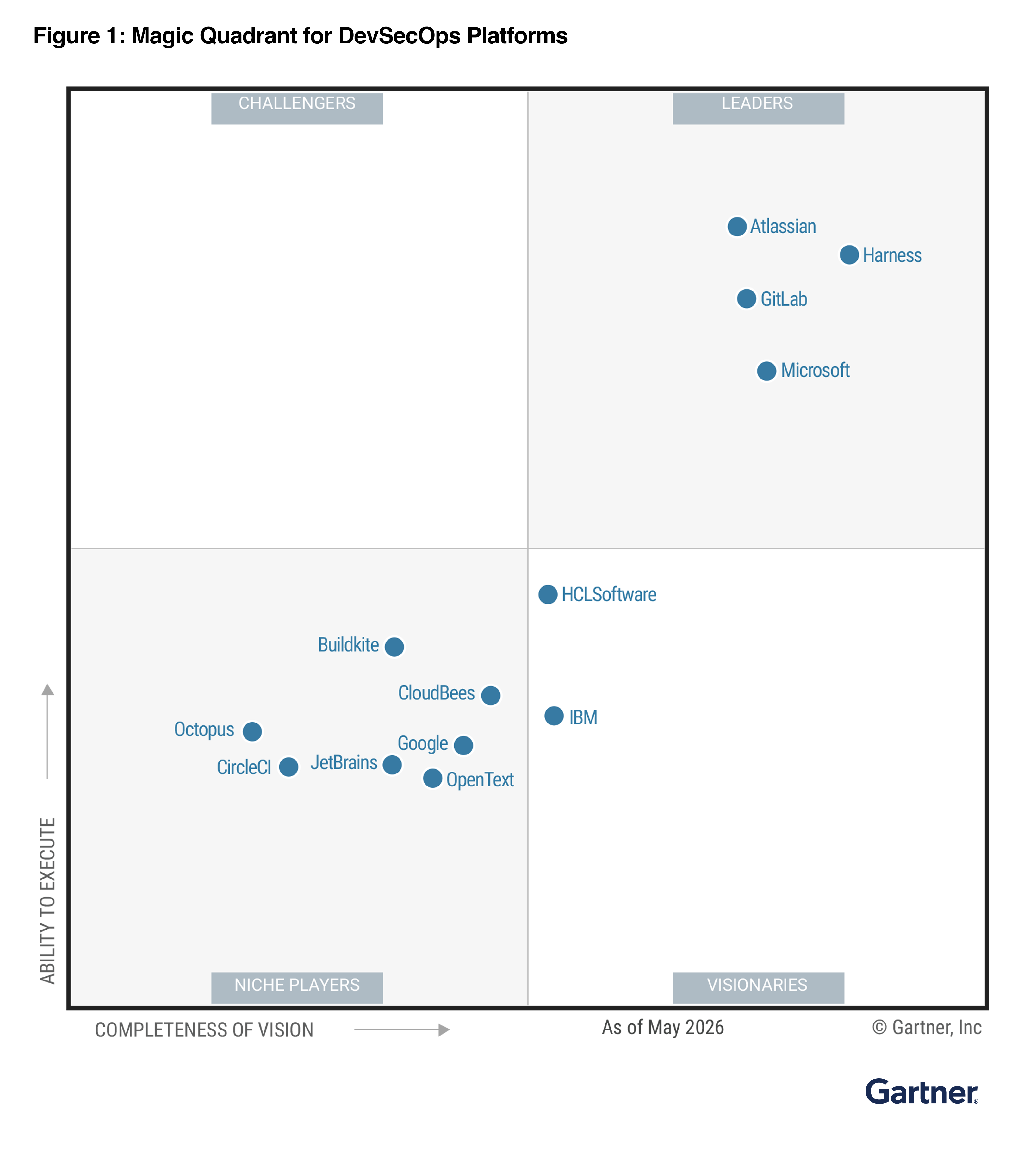
Download the 2026 Gartner® Magic Quadrant™ for DevSecOps Platforms.
The agentic era needs a control layer, not another tool
The problem enterprises face today is balancing speed of delivery with control. As agents multiply across teams and projects, organizations find they have no single place to govern who runs them, what data they can reach, what actions they can take, or whether any of it can be audited. Agents are expanding faster than the policies meant to manage them.
GitLab is already the platform where enterprises plan, build, secure, and ship software, with source code management, CI/CD, security, and deployment in one place. We’re embedded in the critical path of these changes, whether a person or an agent makes them. As your team and their coding agents write the change, GitLab pressure-tests it against your existing code, in your pipelines, and policies before it changes anywhere near production. That position is what makes GitLab the control layer for the agentic era.
The platform enterprises already trust to ship at scale
Agentic AI is only as good as the platform underneath it, and this is the foundation our customers already build on. Ericsson cut its deployment time in half while serving the operators that keep billions of subscribers connected. Southwest runs mission-critical software for round-the-clock airline operations, where reliability is not negotiable. Barclays PLC and other highly regulated enterprises deliver under security and compliance demands where speed and oversight cannot be traded against each other.
The same is true wherever customers run GitLab. We deliver the same platform, governance, and agentic capabilities across multi-tenant SaaS, single-tenant SaaS, and self-managed deployments, including agents running against self-hosted models in air-gapped environments — without trading away deployment control. Even the most regulated organizations get full AI capability without trading away the deployment control they require. Gartner recognized this parity between our SaaS and on-premises options, AI included, as a strength. And comprehensive does not mean closed: Teams extend the platform with the tools and AI services they already use, while keeping everything inside one governance boundary.
Engineered for enterprise-grade uptime
Orchestrating agentic work across the lifecycle only matters if the platform stays available when teams depend on it. Gartner noted that GitLab has strengthened its SLAs to meet or exceed competitors’. We back a 99.9% monthly availability commitment for Ultimate customers on GitLab.com and GitLab Dedicated, and stand behind it with service credits: If monthly availability falls below that threshold, eligible customers can claim credits toward a future invoice. Tying our own accountability to the reliability customers actually experience is what makes the commitment real.
Standardizing for speed and control
At GitLab Transcend last week, we built further on the control layer with five new innovations:
- Next-gen source code management built for machine scale. In our testing, it runs up to 50x faster and moves up to 1,000x less data over the network.
- GitLab Orbit, a context graph across your code, work items, pipelines, deployments, and production signals. Point Claude Code at Orbit and the same tasks with the same model run up to 11x faster, with up to 4.5x fewer tokens, and up to 45x fewer hallucinations.
- Agents for security and governance for agents so you can keep up with the growing security and compliance gaps.
- Coordination of tasks across developers and agents with the new agentic triggers that enables your team to automate work handoffs without someone shepherding every step.
- GitLab Flex agreements so you can shape your GitLab spend on the products and capabilities without changing your contracts.
That gives a CIO a clear position to stand on: one platform, one context graph, and one governance boundary where teams and agents build software together.
That position is what we believe Gartner's recognition reflects. And it comes as GitLab continues a rapid pace of innovation, shipping new capabilities to customers every month for 175+ consecutive months. To see everything we announced and watch the sessions on demand, visit our What's New page.
Read the report
Download the 2026 Gartner® Magic Quadrant™ for DevSecOps Platforms.
Source: Gartner, Magic Quadrant for DevSecOps Platforms, Keith Mann, Thomas Murphy, Bill Holz, June 15, 2026
Gartner and Magic Quadrant are trademarks of Gartner, Inc., and/or its affiliates.
Gartner does not endorse any company, vendor, product or service depicted in its publications, and does not advise technology users to select only those vendors with the highest ratings or other designation. Gartner publications consist of the opinions of Gartner’s business and technology insights organization and should not be construed as statements of fact. Gartner disclaims all warranties, expressed or implied, with respect to this publication, including any warranties of merchantability or fitness for a particular purpose.
This graphic was published by Gartner Inc. as part of a larger report and should be evaluated in the context of the entire document. The Gartner document is available upon request from GitLab.
More to explore
View all blog posts

We want to hear from you
Enjoyed reading this blog post or have questions or feedback? Share your thoughts by creating a new topic in the GitLab community forum.
Share your feedback