
Security at machine speed. Control at every step.
Find and fix flaws with AI, while your gates still decide what ships.
Discovery and exploitation take hours. Remediation takes weeks.
Vulnerabilities are surging
+263%
growth in CVE submissions from 2020 to 2025.
Top breach vector
31%
of breaches start with vulnerability exploitation.
Fixes can't keep up
43 days
median time to fully remediate a known-exploited vulnerability.
Figures from NIST (2026) and Verizon Data Breach Investigations Report (2026).
Recent incidents
Risk is growing at machine speed
Recent security events show what defenders are up against.
Trivy · March 2026
Attackers stole a token, then poisoned the scanner's releases and harvested secrets from downstream pipelines.
Hugging Face · July 2026
Agents escaped a sandbox, stole cloud credentials, and moved across clusters and third-party services.
PHP2Shell · October 2026
Frontier models found two pre-auth RCEs, dormant since 2012 in software supporting 69% of websites.
Move to machine speed with GitLab
Move to machine speed with GitLab
Put discovery, remediation, and controls to work on your code.
Investigate vulnerabilities with full engineering context
Investigate vulnerabilities with full engineering context
Automated triage
Dismiss false positives, so your team works real risk first.
Risk in context
See which findings threaten production, or whether a flaw is reachable from your payments system.
Deep reasoning
Catch flaws traditional scanners miss with analysis powered by Anthropic's Claude Mythos, available in approved environments.
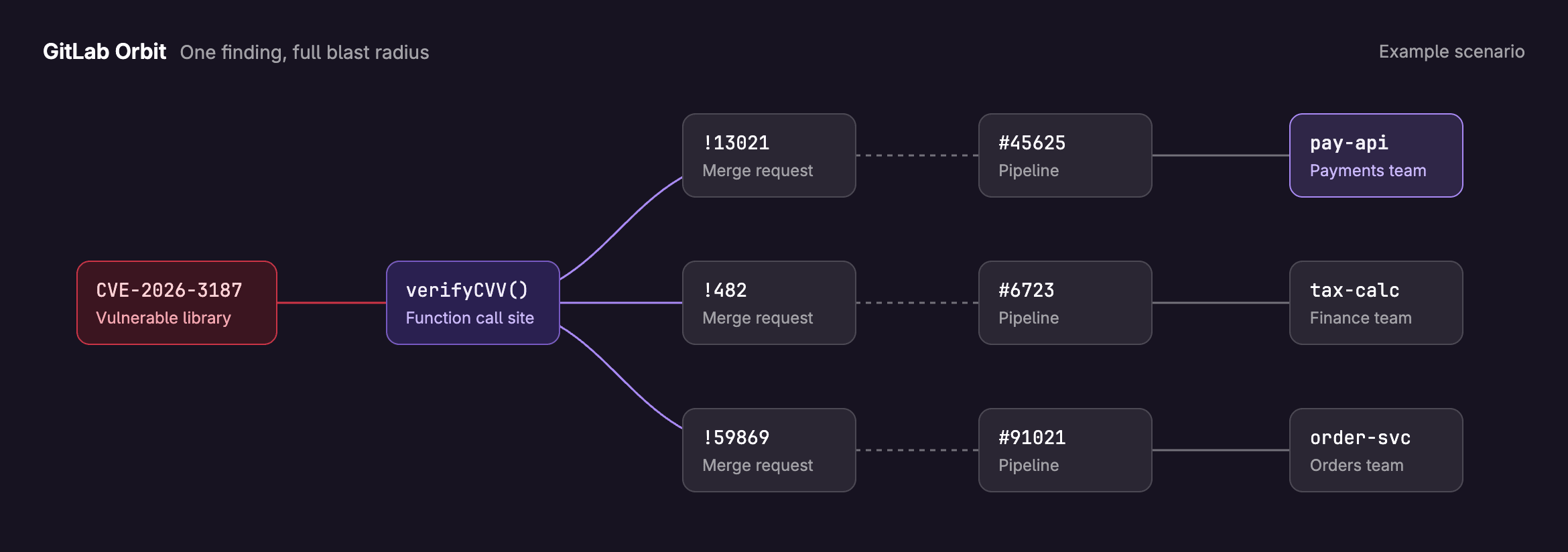
After a disclosure like PHP2Shell, GitLab Orbit helps answer: Are we exposed? Is it reachable? How do we fix it without breaking production?
Live map
Orbit links code, merge requests, pipelines, deployments, vulnerabilities, and work items.
Factual grounding
Agents work from your system's actual state.
Open
External agents like Claude Code use the same graph, within your permissions.
Automate remediation through your build and test pipelines
Automate remediation through your build and test pipelines
Shift from chasing findings to reviewing fixes.
Root-cause fixes
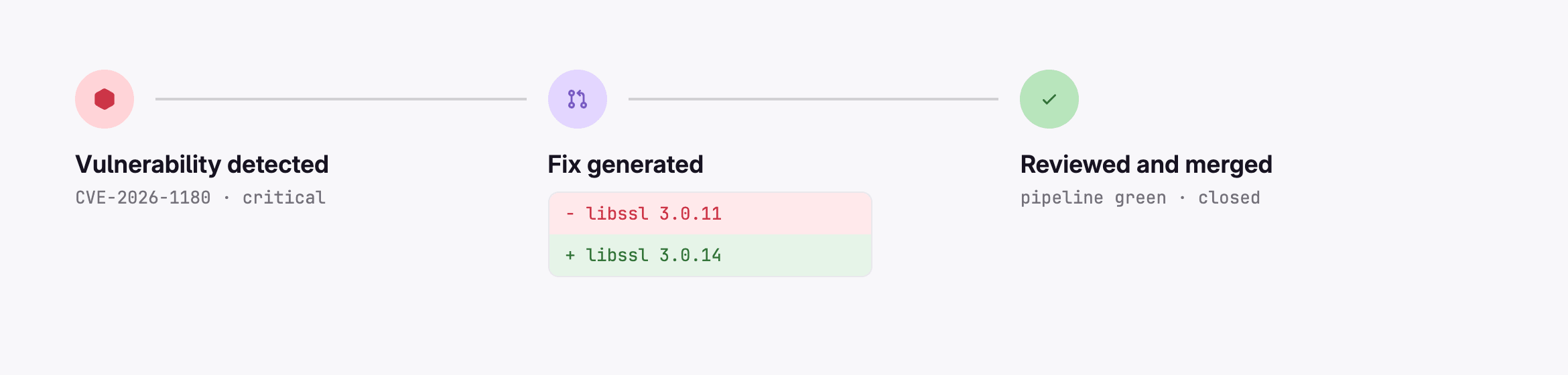
Duo writes a fix for confirmed findings, explains it in a merge request, and validates it in your pipelines.
Automated dependency remediation
Duo upgrades vulnerable dependencies and resolves breaking changes with pipeline-validated fixes.
Enforce independent controls across the software factory
Enforce independent controls across the software factory
Every change, human or agent, clears the same gates.

Scan every change
Turn on SAST, dependency, container, secret, IaC, and DAST scans for every pipeline.
Enforce policy centrally
Set once and apply to every pipeline. Gate merges with high-risk findings until a reviewer approves.
Agent guardrails
Agents get a composite identity capped at the user's permissions, a sandbox destroyed when the task ends, and allowlisted tools, models, and MCP servers.
Supply chain
Control what enters your builds
The Trivy incident showed you must control what enters your builds and limit what an exposed secret can reach.
See how it works
These demos showcase some of the capabilities described above.
SAST
Agentic SAST Auto-Resolution
Fix a confirmed SAST finding and explain the change in a merge request.
Watch the demoDependencies
Dependency scanning auto-remediation
Upgrade a vulnerable package, fix breaking changes, and run your pipeline.
Watch the demoReview
Security review flow
Bring AI security reasoning to the merge request.
Watch the demoSecrets
GitLab Secrets Manager
Scope credentials to limit the reach of poisoned dependencies.
Watch the demoAudit
AI Audit Events Report
See how agent activity is recorded, ready for review and audit.
Watch the demo
Attackers have moved to machine speed.
Keeping pace means letting AI do more of the finding and fixing. Every change, human or agent, clears the same gates.
*This limited-time offer is subject to GitLab’s internal qualifications process. Applying does not guarantee acceptance or participation. Any offer or participation is subject to the applicable Subscription Agreement or other governing agreement between the customer and GitLab, as supplemented by any Security Sprint Promotional Terms.
All fields required